Regenerative Medicine · Oakville, Ontario
Autologous Exosome Therapy
Using the Health Canada–approved MCT System, we precondition your own platelet-rich plasma to release exosomes — the body's most powerful regenerative messengers — directly from your own cells.
What Are Exosomes?
The Body's Regenerative Messengers
Exosomes are nanoscale vesicles — roughly 30 to 150 nanometres across — that cells release to communicate with one another. They carry growth factors, signalling proteins, lipids and microRNAs that instruct neighbouring cells to repair, regenerate and dampen inflammation.
In regenerative medicine, exosomes are considered one of the most active components of the healing cascade. Where standard PRP delivers a burst of platelet contents, exosome-rich preparations deliver concentrated, targeted molecular signals directly into the cells that drive tissue repair.
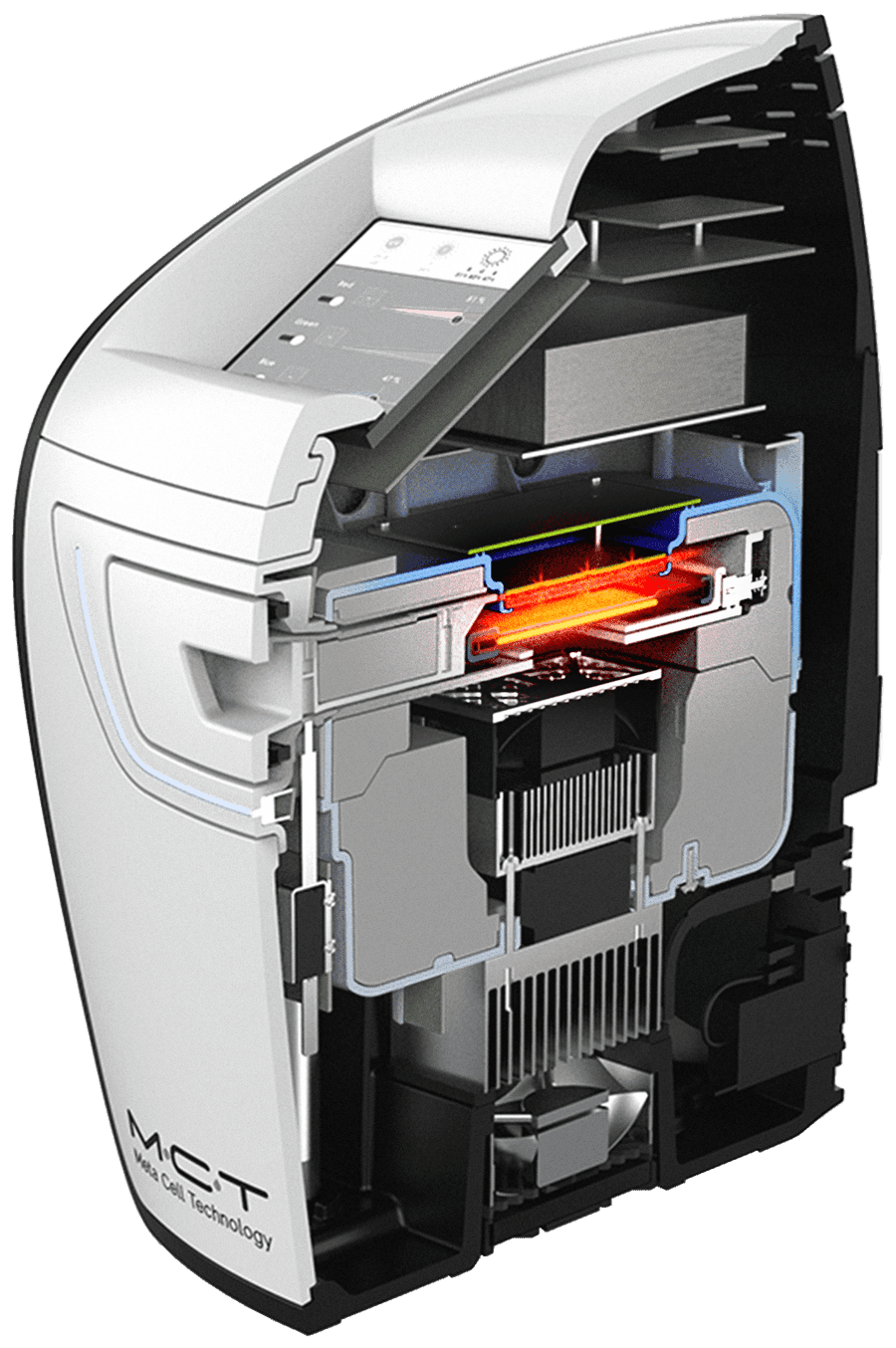
At Oakville Pain Clinic, exosome therapy is performed using the MCT System — a Health Canada–approved photo-thermal device that preconditions your own PRP so your platelets release a far higher concentration of exosomes than standard PRP techniques can produce.
The Technology
The MCT System — Photo-Thermal PRP Conditioning
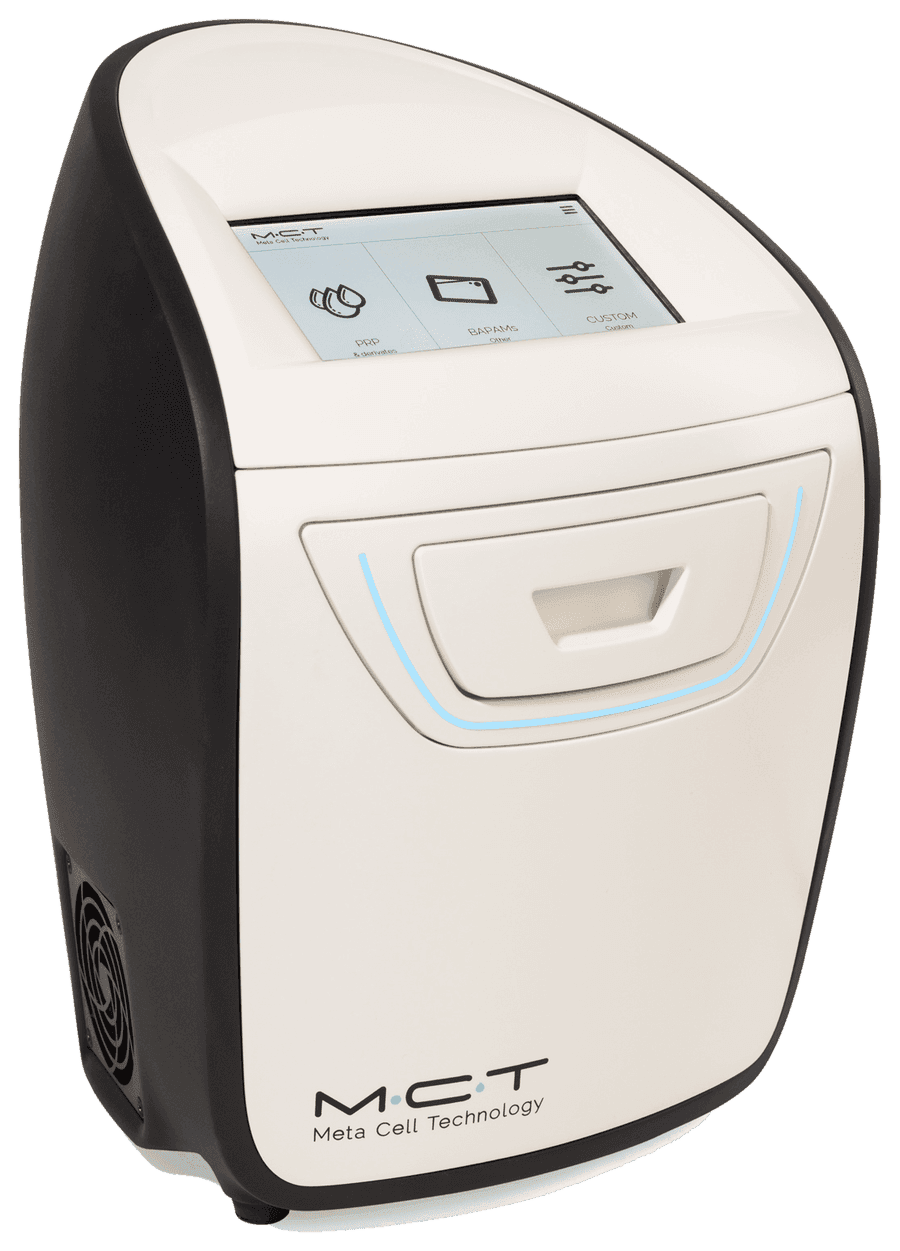
The MCT System (Meta Cell Technology) is a medical device that uses precisely controlled light wavelengths and temperature to precondition autologous PRP. The result, MCT Plasma, contains a substantially higher concentration of exosomes and growth factors than standard PRP.
Health Canada Approved
MCT is licensed as a medical device by Health Canada and carries CE 0051, EU-MDR and ISO 13485:2016 certifications.
100% Autologous
Exosomes are released from your own platelets — no donor cells, no synthetic material.
≈3× Growth Factors
Photo-thermal preconditioning significantly increases EGF, bFGF and VEGF release versus standard PRP.
≈2× ATP Production
Light at therapeutic wavelengths stimulates mitochondrial energy output, priming platelets to perform.
Sustained Release
Growth factors are released gradually for up to 28 days after injection, supporting prolonged tissue repair.
More Comfortable Injection
Thermal conditioning yields a less dense plasma and a softer, less painful injection experience.
Regulatory Status
The MCT System is a Health Canada–approved medical device. It additionally carries CE 0051 marking, EU-MDR conformity and ISO 13485:2016 medical-device quality-management certification. The single-use MCT Kit used in every procedure is a Class IIa medical device with a patented optical geometry.
Applications
Who Can Benefit from Exosome Therapy?
MCT exosome therapy is used as an enhanced regenerative option for patients who would normally be candidates for PRP, particularly those seeking a more potent or longer-acting preparation.
Chronic Tendon Injuries
Achilles, patellar, rotator cuff, lateral epicondyle
Joint Osteoarthritis
Knee, hip and shoulder degenerative pain
Ligament Sprains
Slow-healing or recurrent ligament injuries
Soft-Tissue Repair
Persistent muscle and fascial pain
Plantar Fasciitis
Heel pain that has not responded to conservative care
Sports Injuries
Overuse injuries and accelerated recovery support
Skin & Scar Quality
Adjunctive use for skin biostimulation around treatment sites
Failed Prior PRP
Patients seeking a more potent regenerative option
The Process
From Blood Draw to Exosome-Rich Injection
The full procedure is completed in a single in-clinic visit of roughly 60–75 minutes.
Consultation
Your physician reviews your history, imaging and goals, and confirms whether MCT exosome therapy is appropriate for you.
Blood Draw & PRP Prep
A small blood sample is drawn and centrifuged in-clinic to separate the platelet-rich plasma fraction.
MCT Photo-Thermal Stimulation
Your PRP is loaded into the single-use MCT Kit and processed through the MCT Unit's Exosomes preset, priming platelets to release exosomes.
Targeted Injection
The preconditioned plasma is injected into the treatment area, with ultrasound guidance available for precision targeting.
How It Compares
MCT Exosome Therapy vs. Standard PRP
Both treatments use your own blood, and standard PRP therapy works very well for many patients. The MCT System adds one extra step — photo-thermal preconditioning — that meaningfully changes what your platelets can deliver.
MCT exosome therapy is not a separate treatment from PRP — it's an enhancement of PRP. Your physician will help you decide whether standard PRP or MCT exosome therapy is the right starting point at consultation.
Standard PRP
Concentrated Platelets
- •Platelets are concentrated and injected directly
- •Growth factors release in a relatively short window
- •Lower exosome yield
- •Effective baseline regenerative therapy
MCT Exosome Therapy
Photo-Thermal Preconditioned PRP
- •PRP is preconditioned with controlled light and temperature
- •Significantly higher exosome release from your own platelets
- •≈3× the growth factor concentration of untreated PRP
- •≈2× ATP production for primed platelet performance
- •Sustained release for up to ~28 days after injection
- •Less dense plasma — softer, more comfortable injection
Why Choose Us
Exosome Therapy at Oakville Pain Clinic
Health Canada–Approved Device
We use the MCT System — a Health Canada-licensed medical device with CE, EU-MDR and ISO 13485 certifications. Your treatment is performed with regulatory-grade equipment, not improvised protocols.
Board-Certified Physicians
Every exosome treatment is performed by a board-certified physician trained in interventional pain management and regenerative medicine, with ultrasound guidance available where indicated.
Self-Referral, No Wait
Skip the GP referral — self-refer through our online form and our team contacts you within 24 hours to schedule your exosome therapy consultation.
Frequently Asked Questions
Exosome Therapy Questions
What are exosomes and why do they matter for regenerative medicine?
+
Exosomes are nanoscale vesicles — roughly 30 to 150 nanometres in diameter — that cells release to communicate with one another. They carry growth factors, signalling proteins, lipids and microRNAs that instruct surrounding cells to repair tissue, reduce inflammation and regenerate. Because exosomes deliver these signals directly into target cells, they are considered one of the most active components of regenerative biology.
Where do the exosomes used at Oakville Pain Clinic come from?
+
They come from you. The MCT System we use prepares autologous (your own) exosomes by stimulating your own platelet-rich plasma (PRP) with carefully controlled light and temperature. There are no donor cells, no synthetic exosomes and no foreign biological material — the entire preparation is derived from a sample of your own blood drawn the same day.
Is the MCT System Health Canada approved?
+
Yes. The MCT System is a Health Canada–approved medical device. It also carries CE 0051 marking, EU-MDR conformity and ISO 13485:2016 medical-device quality-management certification. The MCT Kit used in each procedure is a single-use Class IIa medical device with a patented optical geometry that ensures the light energy reaches the platelets evenly and reproducibly.
How is exosome therapy different from standard PRP?
+
Standard PRP injects concentrated platelets that release their contents over a relatively short period after injection. With the MCT System, your PRP is preconditioned using photo-thermal stimulation — specific wavelengths of light combined with controlled cooling — which dramatically increases exosome release, more than doubles ATP production and roughly triples key growth factors (EGF, bFGF, VEGF) compared to untreated PRP. The result is a more physiological, less inflammatory, longer-acting regenerative preparation.
What does the MCT procedure involve?
+
The visit follows the same flow as a standard PRP appointment. A small blood sample is drawn and centrifuged to separate the PRP. The PRP is poured into the single-use MCT Kit, placed inside the MCT Unit, and run through the Exosomes preset — a precisely calibrated cycle of light wavelength, irradiance and temperature that primes the platelets to release exosomes. The preconditioned plasma is then injected into the treatment area, often under ultrasound guidance.
Is exosome therapy painful?
+
Most patients report that the injection is more comfortable than standard PRP. The thermal preconditioning step delays clot onset and produces a less dense plasma, which makes the injection itself feel softer. The blood draw is identical to a routine lab test.
How many sessions will I need and when will I see results?
+
Treatment plans are individualized. Many patients follow a course of one to three sessions spaced four to six weeks apart, similar to standard PRP. Because photo-thermal stimulation produces a more sustained release of growth factors, results often build over several months — early improvement is typical within two to six weeks, with continued benefit through three to six months.
Is exosome therapy covered by OHIP?
+
No. Autologous exosome therapy with the MCT System is a private-pay regenerative procedure and is not covered by OHIP. Many extended-health benefit plans cover a portion of the cost — we issue detailed receipts you can submit to your insurer. Pricing is reviewed in detail at your consultation.
How is autologous exosome therapy different from the exosome treatments offered at aesthetic clinics?
+
It is a fundamentally different treatment. The exosome treatments offered at most aesthetic and dermatology clinics in Canada use donor or laboratory-produced exosomes (brands like BENEV, Purasomes or AMPLEX+) applied topically to the skin or scalp after microneedling, primarily for skin rejuvenation and hair growth. The MCT System used at Oakville Pain Clinic prepares exosomes from your own platelets and injects them directly into joints, tendons and soft tissues for orthopedic regenerative care. We are one of the only clinics in Ontario offering an autologous, injected, photo-thermal orthopedic exosome programme on a Health Canada-approved device.
What conditions can MCT exosome therapy treat?
+
MCT exosome therapy is used for the same musculoskeletal conditions where standard PRP is effective, but typically as a more potent option for patients seeking maximum regenerative response. Common applications include knee osteoarthritis, rotator cuff tendinopathy, tennis elbow (lateral epicondylitis), Achilles and patellar tendinopathy, plantar fasciitis, hip pain (gluteal tendinopathy), wrist and thumb-base osteoarthritis, and chronic sports injuries.
How long do exosome therapy results last?
+
Photo-thermal preconditioning produces a sustained release of growth factors for up to approximately 28 days following injection, supporting prolonged tissue repair. Most patients report continued improvement over 3 to 6 months as new tissue forms and remodels. As with PRP, results vary by condition, severity, age and individual healing response.
Does exosome therapy work better than PRP?
+
MCT exosome therapy is essentially photo-thermal-enhanced PRP — it builds on the same regenerative principle but produces substantially more exosomes, growth factors and ATP than untreated PRP (≈3× growth factors and ≈2× ATP in published studies). For most patients standard PRP works very well; exosome therapy is the option to consider when you want a more potent regenerative response, when prior PRP has plateaued, or for harder-to-treat chronic tendinopathies.
Do I need a referral for exosome therapy in Oakville?
+
No. We accept self-referrals — you can book directly through our online self-referral form or by phone (647-910-5359) and our team contacts you within 24 hours. We also accept referrals from family doctors, sports-medicine physicians, physiotherapists and chiropractors.
Is the MCT System the same one used at Toronto hair restoration clinics?
+
Yes — the MCT (Meta Cell Technology) System is also used by some Toronto hair-restoration and dermatology clinics for aesthetic exosome treatments. We use the same Health Canada-approved device, but for a different application: orthopedic regenerative care, with autologous exosomes injected into joints, tendons and soft tissues — not topically applied for skin or hair. Same technology platform, very different use case and clinical training.
What does the clinical evidence actually say about exosome therapy?
+
We aim to be honest about this. Most published research on regenerative joint and tendon care is on PRP (over 100 randomized clinical trials) rather than on dedicated orthopedic exosome therapy. The MCT System is best understood as an enhancement of standard PRP: photo-thermal preconditioning has been shown to substantially increase exosome release, growth-factor concentration and ATP production from your own platelets compared to untreated PRP. So MCT exosome therapy builds on PRP's well-established evidence base rather than being a fundamentally separate treatment with its own large body of orthopedic RCTs. Dedicated orthopedic studies of MCT-style autologous exosome therapy are an emerging area. We discuss this honestly with every patient at consultation so you can make an informed choice between standard PRP and MCT exosome therapy.
How much does autologous exosome therapy cost in Oakville?
+
Autologous exosome therapy with the MCT System is a private-pay procedure not covered by OHIP. Pricing varies based on the treatment area, the number of sessions recommended for your condition, and whether ultrasound guidance is used. Detailed pricing is reviewed at your consultation, and we issue itemized receipts you can submit to your extended-health insurance — many plans cover a portion under regenerative medicine, sports medicine or specialist injection benefits.
Ready to Start?
Book Your Exosome Therapy Consultation
No physician referral required. Self-refer today and our team will contact you within 24 hours to schedule your MCT exosome consultation.
How We Differ
Orthopedic Exosomes vs. Aesthetic Exosomes
Most clinics offering “exosome therapy” in Canada do aesthetic exosomes — donor-derived or laboratory-produced exosomes (brands like BENEV, Purasomes or AMPLEX+) applied topically to the skin or scalp after microneedling, for skin rejuvenation and hair growth. Oakville Pain Clinic offers orthopedic exosomes: your own exosomes, injected directly into joints, tendons and soft tissues for musculoskeletal regeneration. The two treatments share a name, but very little else.
We are one of the only clinics in Ontario offering an autologous, injected, photo-thermal orthopedic exosome programme on a Health Canada-approved device — and the only one combining it with board-certified interventional pain physicians and ultrasound guidance.
Sources & References
The clinical and regulatory information on this page is drawn from the following peer-reviewed studies and authoritative sources:
- 1.Asghar S, et al. Exosomes: roles and therapeutic potential in osteoarthritis. Bone Research (Nature), 2020.
- 2.Effect of Exosome Size in Platelet-Rich Plasma on Outcomes in Patients Treated for Knee Osteoarthritis. PMC, 2025.
- 3.Centeno C. Exosomes (Extracellular Vesicles) vs. PRP Used for Treating Orthopedic Problems — a critical perspective on the orthopedic exosome evidence base.
- 4.American Academy of Orthopaedic Surgeons (AAOS) — Platelet-Rich Plasma (PRP). OrthoInfo.
- 5.Lan Z, et al. PRP Injections for the Treatment of Knee Osteoarthritis: Meta-analysis of Randomized Controlled Trials. PubMed, 2024.
- 6.Meta Cell Technology (MCT) — manufacturer technical and regulatory documentation (CE 0051, EU-MDR, ISO 13485:2016, Health Canada).
Dedicated orthopedic randomized controlled trials of MCT-style autologous exosome therapy are an emerging research area. The MCT System builds on the well-established PRP evidence base rather than constituting a separate body of orthopedic clinical evidence. The information on this page is for general educational purposes only and is not a substitute for personalized medical advice.
Exosome Therapy in Oakville — Serving the Halton Region & GTA
Oakville Pain Clinic offers autologous exosome therapy in Oakville, Ontario, using the Health Canada-approved MCT System. By preconditioning your own platelet-rich plasma with controlled light and temperature, the MCT device prompts your own platelets to release exosomes — nanoscale carriers of growth factors and regenerative signals — used to treat knee osteoarthritis, rotator cuff tendinopathy, tennis elbow, Achilles and patellar tendinopathy, plantar fasciitis, hip pain (gluteal tendinopathy), wrist pain and chronic sports injuries.
We treat patients seeking autologous exosome therapy across the Halton Region and the Greater Toronto Area — including all Oakville neighbourhoods (Bronte, Glen Abbey, West Oak Trails, Joshua Creek, Iroquois Ridge, College Park, Old Oakville, Eastlake, Clearview), as well as Burlington, Mississauga, Milton, Hamilton, Halton Hills (Georgetown and Acton), Brampton, Etobicoke and Toronto. Our clinic is at Unit 7, 1400 Cornwall Road in Oakville, easily accessible from the QEW, 403 and 407.
If you're searching for autologous exosome therapy near me, MCT exosomes Oakville, Health Canada-approved exosome therapy in Ontario, or orthopedic exosome injections in the GTA, contact Oakville Pain Clinic at 647-910-5359 or self-refer online. You may also be interested in our standard PRP therapy — same blood-derived treatment without photo-thermal preconditioning, often the right starting point for many musculoskeletal conditions.